
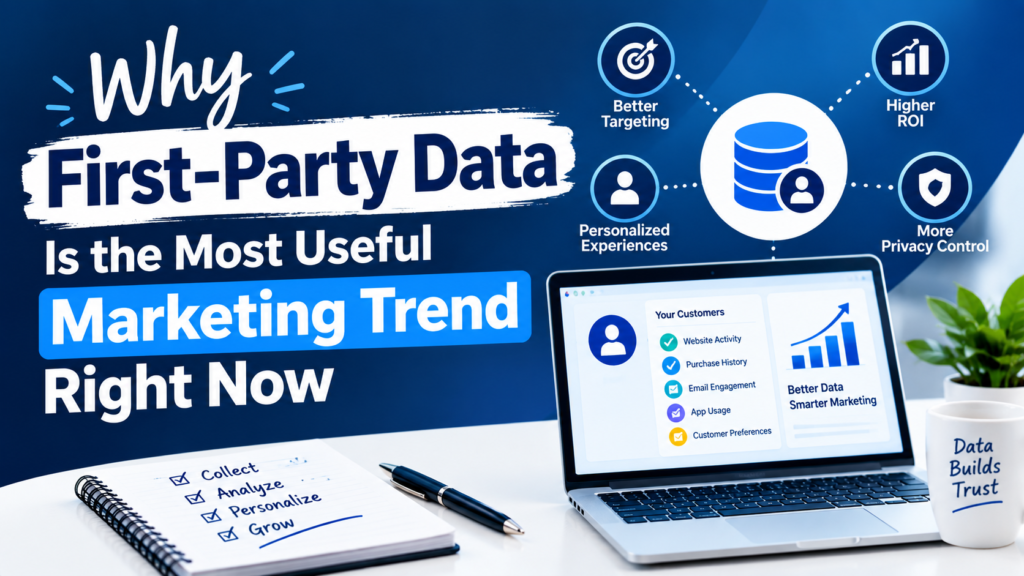
Marketing trends come and go, and plenty of them are just new labels on old habits. One shift is different: the move from borrowed audience data to information customers share with you directly. It changes how businesses of every size find, keep, and understand their customers, and it pays off in ways that go beyond compliance.
What first-party data actually means
First-party data is information you collect yourself, through your own channels, with the customer’s knowledge. That includes email sign-ups, purchase history, survey answers, account preferences, app behavior, and the questions people ask your support team. The alternative, third-party data, is compiled by outside companies that track people across many sites and sell the resulting profiles.
For years, third-party tracking was the backbone of online advertising. That foundation has weakened. Browsers block trackers by default, mobile operating systems require explicit permission for tracking, and privacy laws in many regions demand clear consent. Marketers who depended on invisible tracking have had to rethink their approach, and the ones who invested in direct relationships are in a stronger position.
Why it works better, not just differently
It would be easy to treat this as a defensive move, something you do because regulators and platforms force you to. In practice, the data itself is simply better.
It is more accurate. When someone tells you they are shopping for a first apartment, that beats any guess drawn from browsing patterns. Inferred interests are often wrong, outdated, or based on a shared device. Declared interests come straight from the person.
It is yours. If your entire audience lives on one social platform, a single algorithm change can cut your reach in half. An email list or customer database does not disappear when a platform changes its rules. This gives you stability that rented audiences never can.
It builds trust. People are more aware of how their information is used than they were a decade ago. Businesses that explain what they collect and why, and then deliver something useful in return, earn goodwill that shows up in open rates, repeat purchases, and referrals.
It sharpens measurement. Without cross-site tracking, marketers can no longer assume a dashboard tells the whole story. That has pushed teams toward better habits: asking customers how they found the business, running holdout tests to see what a campaign truly added, and comparing channels by revenue instead of clicks.
How to put it into practice
The idea is simple, but it takes deliberate effort. Here are the steps that tend to matter most.
Give people a real reason to share. Nobody hands over information for nothing. A local bakery might offer a birthday treat in exchange for a date and email address. A software company might offer a free template or an assessment that produces personalized results. The exchange should feel fair and immediate.
Ask for information gradually. A long sign-up form scares people away. Start with an email address, then learn more over time through preference centers, short polls, and behavior. This is sometimes called progressive profiling, and it respects the customer’s patience.
Be transparent. Say plainly what you collect, how you use it, and how to opt out. Clear language beats a wall of legal text. Transparency is also the safest way to stay compliant with privacy regulations.
Use the data to make things easier for the customer. Personalization works when it saves someone time: recommending the right refill, skipping a promotion for something they already bought, or sending a reminder when they usually reorder. It backfires when it feels invasive, so if a message would make a customer wonder how you knew, it probably goes too far.
Connect your systems. Data scattered between a website, an email tool, a point-of-sale system, and a spreadsheet is hard to use. Even a simple setup that brings these together gives you a clearer picture of each customer.
The honest downsides
This approach is slower than buying ads. Building a list of ten thousand engaged subscribers takes months or years, while a paid campaign can reach that many people in a week. It also requires ongoing care: keeping data clean, respecting opt-outs, and protecting what you store. A security breach involving customer information can do serious damage to trust.
There is also a temptation to collect everything just in case. That is a mistake. Every extra data point is something you must secure and justify, so collect what you will actually use.
Why it compounds
Paid advertising stops producing results the moment you stop paying. A well-tended base of first-party relationships keeps working. Every subscriber, loyal customer, and survey response adds to an asset that gets more valuable as you learn from it. Your emails improve because you know what people respond to, your product decisions improve because you hear directly from buyers, and your ad spending becomes more efficient because you can build audiences from customers who already like what you do.
For small and mid-sized businesses without huge budgets, this is especially valuable. You cannot outspend larger competitors on ads, but you can know your customers better and treat them better.
The takeaway
The most useful digital marketing trend is not a new platform or a clever tactic. It is a change in mindset: treat customer information as something earned through trust rather than taken through tracking. Businesses that adopt that mindset gain better data, steadier channels, and stronger relationships, and those benefits last regardless of which platform or algorithm changes next.
This is written from scratch, but before publishing it, run it through a plagiarism checker such as Grammarly or Copyscape, and add your own examples or statistics to make it distinctly yours. I can also put it in a Word or Markdown file if you’d like.